
Introduction
Fortunately, there are many people, companies and organizations who want to act sustainably, ultimately it starts with yourself. Unfortunately, this is really not enough, we cannot escape the fact that regulation is needed to get a more sustainable world. Without regulation, we will never become sustainable enough. I am therefore a supporter of regulations on sustainability, however, it is important that the regulations are correct and enforceable.
With the huge growth and incredibly large impact that data centers can have in areas such as energy, regulatory compliance is vital. Besides regulation, transparent insight into data is key. What exactly are we talking about, where can we do better and what can we learn from others. More importantly, is the company you want to do business with as sustainable as they say they are? This is therefore the reason why more and more insight into a company is needed, and the EU Taxonomy is a great example who to get more insights. Also data centers want to comply with the EU Taxonomy. One of the requirements for the EU Taxonomy is that the data center will be audited on the “EU Code of Conduct for data centers best practices”.
When this article refers to the EU Code of Conduct, it may also refer to a similar document such as EN50600-99-1 or EN50600-5-1.
EU Taxonomy
The EU taxonomy is a cornerstone of the EU’s sustainable finance framework and an important market transparency tool. It helps direct investments to the economic activities most needed for the transition, in line with the European Green Deal objectives. The taxonomy is a classification system that defines criteria for economic activities that are aligned with a net zero trajectory by 2050 and the broader environmental goals other than climate.
Source: https://finance.ec.europa.eu/sustainable-finance/tools-and-standards/eu-taxonomy-sustainable-activities_en
EU Code of Conduct
The Data Centres Energy Efficiency Code of Conduct has been established in response to increasing energy consumption in data centres and the need to reduce the related environmental, economic and energy supply security impacts. The aim is to inform and stimulate data centre operators and owners to reduce energy consumption in a cost-effective manner without hampering the mission critical function of data centres. The Code of Conduct aims to achieve this by improving understanding of energy demand within the data centre, raising awareness, and recommending energy efficient best practice and targets.
Source: https://e3p.jrc.ec.europa.eu/communities/data-centres-code-conduct
The EU Code of Conduct for data centers is a framework to identify opportunities in data centers, a collection of best practices which was not meant and developed as an auditing framework, there is also no certification possible.
ISO50001 Energy Management
ISO 50001 is based on the management system model of continual improvement also used for other well-known standards such as ISO 9001 or ISO 14001. This makes it easier for organizations to integrate energy management into their overall efforts to improve quality and environmental management.
ISO 50001 provides a framework of requirements for organizations to:
- Develop a policy for more efficient use of energy
- Fix targets and objectives to meet the policy
- Use data to better understand and make decisions about energy use
- Measure the results
- Review how well the policy works, and
- Continually improve energy management.
Source: https://www.iso.org/iso-50001-energy-management.html
The EU Code of Conduct best practices consists of more than 100 possible areas of improvement which not only need to be checked but it must also be supported by evidence. Many data centres already comply to a large extent with the EU Code of Conduct, this is because it is in the interest of the data centre organisation to have a low Power Usage Effectiveness(PUE). This document does not elaborate on PUE; for more information on this, please refer to ISO/IEC 30134-2
A lot of energy can be saved with a low PUE. Customers therefore expect a data centre organisation to have a process in place for continuous PUE improvement.
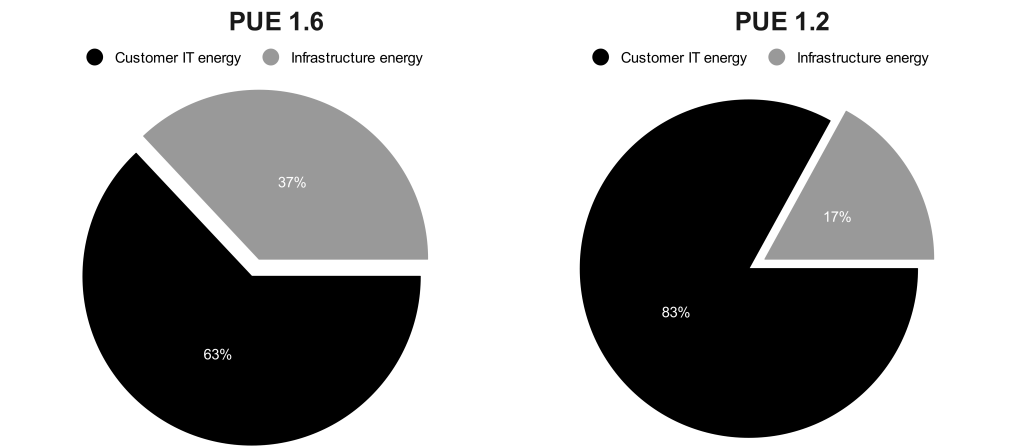
At a PUE of 1.6, around 63% of the total energy can be usefully consumed by IT, at a PUE of 1.2 around 83% of the total energy can be usefully consumed by IT, this is a gain of 20%.
Initially, applying the Taxonomy and thus the EU Code of Conduct seems a logical step but is this really the case? Isn’t it perhaps a lot of unnecessary work for data centre organisations to collect all the evidence, a burden that also results in well-trained technical staff mainly supporting compliance rather than actually implementing projects that lead to more energy savings and sustainability?
However, the question is why EU taxonomy requires data centers to be assessed against the EU Code of Conduct or a similar document, especially obtaining and providing evidence takes a very long time, rather than going through a checklist. Many parts of the EU Code of Conduct have been applied for many years, simply because it is the logical thing to do, no evidence of each best practice has been recorded before.
ISO/IEC 30134 Data Centers | Key Performance Indicators
As a data centre industry, we do want to provide insight, so for many years several Data Centre Key Performance Indicators have been included as an international standard, the ISO/IEC 30134. More and more regulations refer to this ISO/IEC 30134, it is even quite possible that the data centre industry is leading the way with these KPIs which can be used to determine and share the efficiency of various things. These include the PUE, WUE, CUE, ERF, REF, CER, ITEU, ITEE.
More information can be found at the Datacenter Jedi standards
The most well-known KPI is the PUE which gives a good insight into the energy efficiency of the data centre infrastructure which is the energy required so that the IT equipment is 24×7 available. An example of the data centre infrastructure would be for example the cooling installations.
However, the PUE is a number at a given time, or, say, over a whole year, and the question, of course, is how this number compares with the past and the future. Has the PUE improved and what other opportunities are there to keep improving it.
It therefore makes sense for a data centre organisation to apply the EU Code of Conduct best practices, however, the question is whether each individual component should be audited or not.
The data centers are already audited on their PUE within the ISO50001 Energy Management program which can be seen as a much more efficient way.
Conclusion
A vast majority of data centres have already applied ISO50001 Energy Management based on PUE. With the ISO50001, new targets are set continuously, there is a process instead of continuous improvement.
So why do we still need the review of the EU Code of Conduct for data centres?
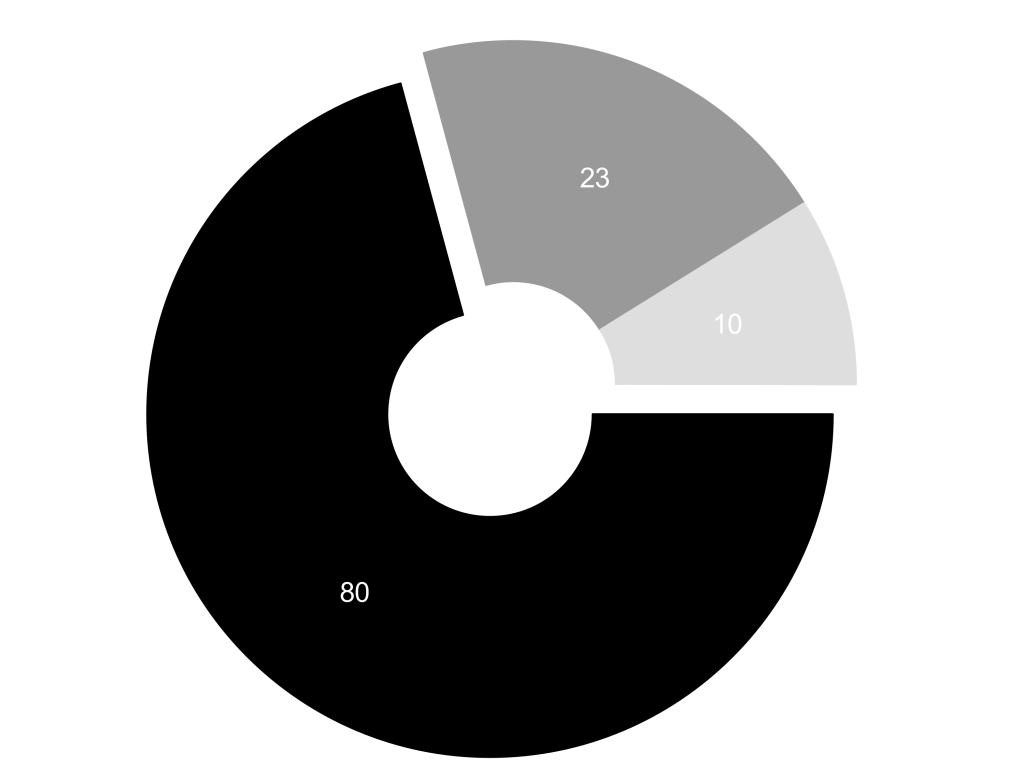
- Applying the EU Code of Conduct version from 2023, a data centre should be audited on around 122 best practices. Of these 122, 23 are IT-related, they do not directly impact the data centre infrastructure. They can be applied well by a hyperscale data centre organisation, however not, or to a much lesser extent, by a collocation data centre organisation.
- Almost 100 best practices can be applied on the data centre infrastructure and 80 of these are already directly or indirectly related to the ISO50001 Energy Management, 10 of them can be linked to other ISO standards
- Unlike the EU Code of Conduct on which a data center organization cannot be certified, most data centers are already ISO 50001 certified by an external auditor. To achieve a lower PUE, the data centers already adopted many elements of the EU Code of Conduct.
- Both the EU Code of Conduct and ISO50001 aim to reduce energy consumption, i.e. lower PUE.
- The EU Code of Conduct can be seen as a checklist of best practices, the ISO50001 is an energy management system of continuous improvement of the PUE (in the case of data centres). Evidence must be provided for both, however, here is the big difference.
- This evidence is not only provided by a compliance team, in many cases technical people will have to support the compliance team and cannot perform work that actually leads to energy savings.
- Data centre specialists will spend much more time on auditing (supporting compliance teams) than on working on actual benefits for energy efficiency and sustainability
- It is the interest of data centres to achieve positive ISO 50001 & ISO/IEC 30134 results.
Suggestion
Suggestion for the auditing of data centres
- Work with existing international standards (ISO50001) to avoid duplication of audits.
- Where the goal of policy is the result of the process, it would be better to focus on the result of the process in stead of the process itself to prevent double auditing.
- Keep the EU Code of Conduct voluntary and make more use of already adapted ISO standards in the EU Taxonomy that achieve the same end results.